


How to get the best out of your subject - Part 2: Directing your subject.

So in last week's post, we talked about what to say and how to say it from behind the camera. This week, I want to talk more about the general idea of directing your subject to get a good performance out of them.
I've photographed thousands upon thousands of people in my 30 plus year career, including lots of celebrities and professional models, but I have almost certainly photographed more people who are not used to being in front of camera.
And that's where things get a bit trickier.
I've always found there's an inherent contradiction to being in front of the camera. You see, on the one hand, if you're in front of camera, you're the subject, you need to be very, very self conscious. You need to be aware of the way you stand and how it might affect how you look on camera, the way you move and how those moves might come across on camera.
You need to be conscious of of what you're wearing and how the fabric is falling, how your expression will come across. You need to be conscious of all those things as a subject.
At the same time, a subject needs to be very unselfconscious. They need to be free of any self-consciousness because what they're being asked to do might be very, very daft indeed. They might be wearing a silly costume, they might be dressed in all sorts of weird ways, or not wearing very much at all. Or they might be doing something in public, and if they stop for a minute, and thought, oh my God, what am I doing? They'd probably freeze up and get very anxious.
So you've got these two contradictory things going on, which I've always thought is rather difficult. It's why directing is so important. In order to get a good performance out of your subject and try and overcome this contradiction.
Here's a key concept that can really help. I find it useful to bear in mind that pretty much anything that's happening in front of the camera, even if you're going for a very naturalistic response from your subject, will be some kind of performance. You're asking your subject to act in a certain way, to look or behave in a certain way.
As a director, as long as you're clear about what it is you want from the shot, that's what you're trying to get out of your subject. That's the performance you're trying to elicit. Now, it might be a very naturalistic performance, but it will still be a performance unless you're doing purely candid photography and the subject has no idea that you're taking their picture, (which isn't really what we're talking about here.)
Performance is the key word. There's a huge crossover between us as photographers trying to get a good performance out of a subject in front of the camera, and the role a director plays in film and TV. In film and TV they are trying to get an ensemble performance out of all their actors, that fits the theme of the piece, and suits each scene.
They might often do several takes, to get this performance right as you probably know. That's the role of a director in that situation. And as photographers, our role is very similar indeed. We know, hopefully we know, what we're trying to get out of the shot and therefore what performance we want from our subject. So as a director, it's our job to try and tease that performance out.
Here are a few basic tips to try and make it a bit easier, and hopefully make you more successful.
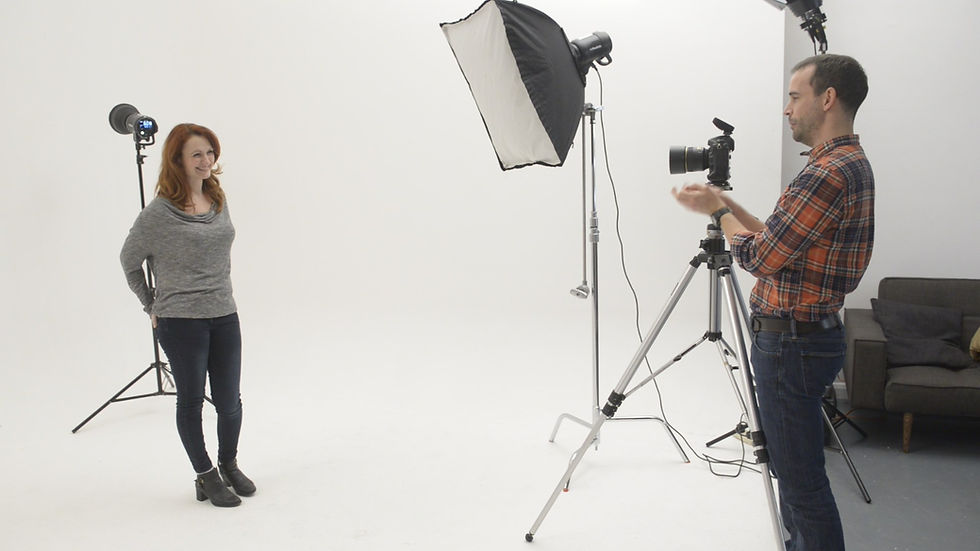
First off. It can help sometimes to basically demonstrate what you want your subjects to do. Simply act out poses, moves or expressions as best as you can.
It always helps to be consistent with the direction. I always try and use the subject's left or right for the directions I'm giving them rather than my own, but whatever you choose to use make sure you're consistent.
Be precise about what you want. Don't say "just move your head a bit". Say, "move your head until the eyeline is over there" or "take a very small step in that direction", not "take a step", because a step could be an entire stride, or it could be a little tip toe. Be as specific as you can. Give directions precisely, not vaguely.
I touched upon this in last week's post, but always try and be positive. Reinforce good things. Use positive, encouraging language as much as you can, even if you start sounding like Austin Powers again. There's no harm in that at all - in fact, I encourage it.
You're far better off building people up, particularly with specific stuff you want them to do if they're doing something good, and keep reinforcing that. Keep encouraging that, rather than giving them vague, woolly open-ended terms that don't really mean anything.
Don't be afraid to make a fool of yourself. There's an old saying about photographing people that there's only one ego allowed on set, and that's the person in front of the camera, not behind the camera.
What matters is the performance that ends up on camera. If that means you look a bit of a prat on the way to getting it, so be it. Not a problem. Sacrifice your ego.
Lastly, if your subject is really worked up, really tense, really nervous, what can be very beneficial is having a little break. Put the camera down, get rid of that barrier between you and the subject and talk to them. Calm them down. I find what can often really help is reinforcing with them that idea that it's a performance.
With a subject that's particularly reluctant to be on camera, it can really benefit them to bolster that idea that it's not "them" you're photographing, but a performance they're putting on - almost a mask they're wearing. I find that can very often help them to sort of overcome that self-consciousness once they realize, "oh, I'm kind of showing off - I'm performing, I'm putting on a role". That can be a big, big step to getting the performance you want out the front of the camera.
Now directing is of course a huge topic. And there's a massive crossover, as I mentioned earlier, between what we do as photographers and what directors do in film and TV. If it's a topic that interests you, I'd highly recommend doing a deep dive into documentaries on how some of the famous directors work throughout the years, because you'll pick up no end of really good tips about how to get a great performance out of your subject from the camera.


Comments